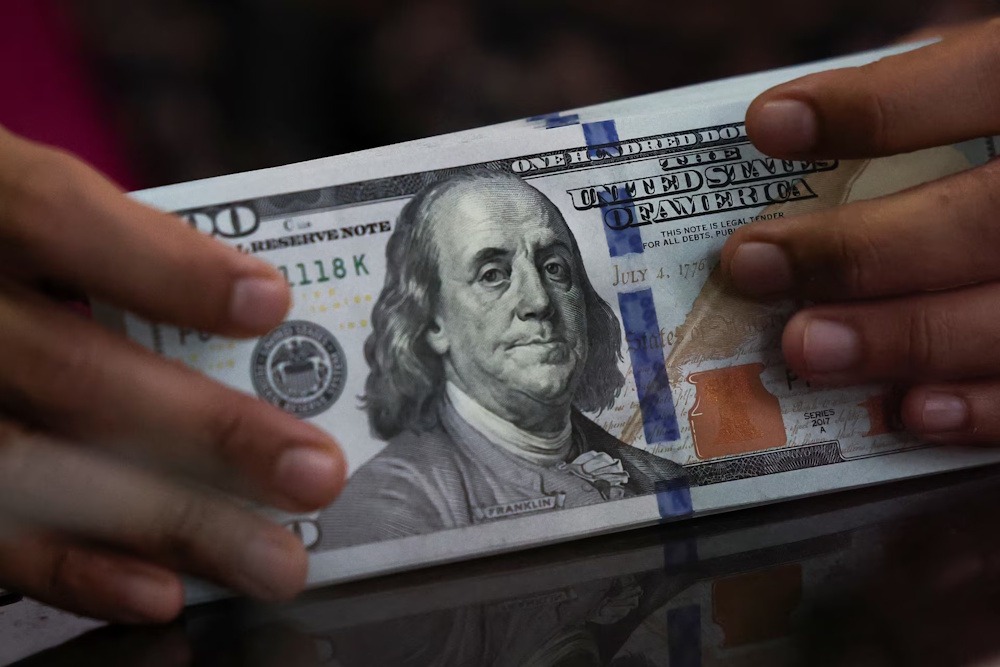
The US dollar traded close to a 1-1/2-year high against the euro and a seven-month high against the Australian dollar on Monday, following a significant surge on Friday, the largest in nearly six months, driven by strong US jobs data that increased expectations for higher interest rates. New Zealand’s currency rebounded from a seven-month low following weekend elections that resulted in a government weakened by a close contest. However, the nation will have to wait until late this month for the final outcome, as vote counting is still ongoing. The US dollar index, which measures the currency against six major rivals including the euro, remained stable at 102.20 early on Monday, following a notable increase of approximately 0.7% on Friday. This uptick coincided with data indicating that jobs growth accelerated in October, accompanied by a decline in the unemployment rate.
The euro increased by 0.1% to $1.11485, following a decline of 0.7% on Friday, which brought it down to a low of $1.1132. This level is close to the previous week’s low of $1.1105, marking the weakest point since May 2025.
The Aussie increased by 0.3% to $0.6875, following a decline of more than 1% on Friday, reaching its lowest point since March 31 at $0.6855. The dollar eased 0.2% to 158.185 yen, following Friday’s 0.6% jump. Bank of Japan Governor Kazuo Ueda stated on Friday that the central bank anticipates underlying inflation to remain near its 2% target, while acknowledging the presence of “some upside risks.” Futures indicate approximately 79% probability that the US Federal Reserve will increase rates on December 9, up from 71% the previous week, as per CME Group’s FedWatch tool. Bets on Fed tightening next month had been receding amid a rout in global tech stocks as investors expressed concerns regarding the outlook for AI investment, profitability, and regulations, particularly following the Democrats’ sweep in the US midterm elections earlier this month.
“The Blue Sweep has put the AI trade to the test given risks for heavier AI regulation and a slow down in the CAPEX cycle. At the same time, however, economic realities continue to surprise to the upside – data momentum remains very strong across indicators,” strategists wrote in a report. “This combination is yet to dent the dollar’s appeal.” Comments from Federal Reserve officials on Friday reinforced expectations for an increase in interest rates. New York Fed President John Williams noted that US economic growth has demonstrated notable resilience amid a series of shocks; however, he emphasised that inflation remains excessively high and it is crucial to restore it to the target of 2%. Separately, St. Louis Fed President Alberto Musalem indicated that inflation continues to be a primary concern in discussions with businesses in his Midwestern district. Meanwhile, Fed Bank of San Francisco President Mary Daly suggested that the Fed will likely need to implement additional rate hikes, even in light of the “painful” selloff in tech stocks.
Sterling increased by 0.1% to $1.3360, whereas the greenback decreased by 0.1% to C$1.4119. On Friday, the US currency experienced a notable increase of 1.1% against Canada’s loonie, following the release of Canadian data that revealed unexpected job losses. The New Zealand kiwi experienced a 0.4% increase to $0.5557 on Monday, recovering from a low of $0.5529 observed at the end of the previous week. Preliminary results in the New Zealand elections indicate that Prime Minister Christopher Luxon’s National Party, along with ACT New Zealand and New Zealand First, has secured 67 seats in a 131-seat parliament, surpassing the 66 seats necessary for a majority. However, close to 400,000 votes, representing nearly 15%, remain uncounted, with official results anticipated by November 27. Both Luxon and Labour leader Chris Hipkins have indicated that they will await the final results before commencing formal coalition negotiations.