
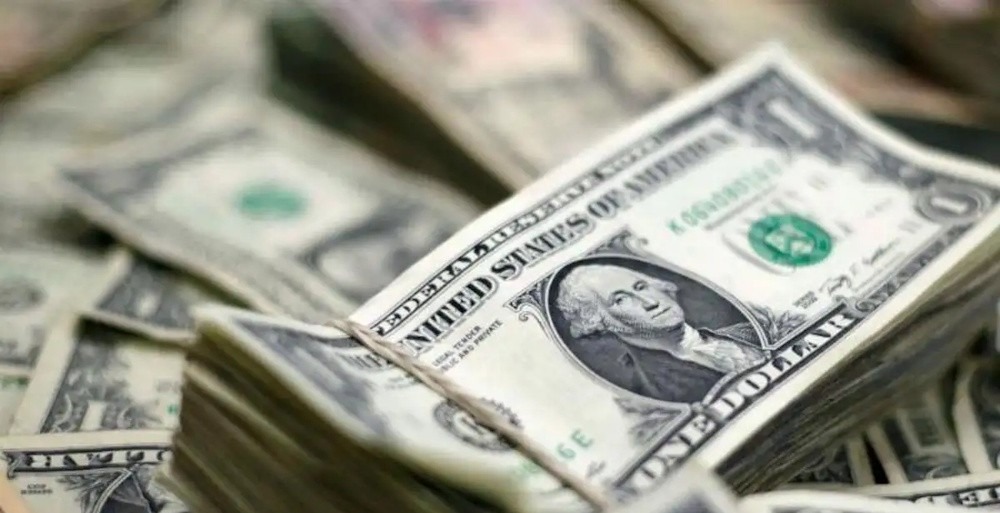
The dollar experienced a decline on Monday as market participants interpreted the U.S. Supreme Court’s ruling to invalidate a majority of President Donald Trump’s tariffs as a positive signal for global economic expansion. However, uncertainty and potential conflict in the Middle East limited the extent of these movements. The euro increased by 0.4% to $1.1823, while sterling also saw a similar rise to $1.3521 during early trading in Asia, which was somewhat subdued due to a holiday in Japan and the Lunar New Year break in China. The dollar experienced a decline of 0.4%, settling at 154.42 yen. The Supreme Court determined on Friday that Trump’s extensive tariffs surpassed his legal authority. Trump has reacted by criticizing the court and implementing a comprehensive 15% tax on imports, while also asserting that agreements with trade partners involving higher tariffs should remain in effect. “It weakens the dollar in the sense that it potentially benefits non-U.S. growth,” stated Sim Moh Siong. He indicated that the longer-term implications for foreign exchange remain uncertain, as a decline in U.S. revenues could adversely affect the fiscal position and the dollar. Conversely, a limitation on Trump’s power might serve as a positive factor by reducing a source of policy volatility.
The New Zealand and Australian dollars experienced a slight uptick in morning trading, with the Australian dollar surpassing 71 cents and the New Zealand dollar remaining just below 60 cents. The safe-haven Swiss franc increased by 0.5% to 0.7716 francs per dollar. “This decision is another chip away at Trump’s power … so that’s a positive for markets,” stated Jason Wong. However, numerous factors are at play, with various moving parts involved, making it non-tradable. In addition to tariffs, market participants are closely monitoring the U.S. military buildup in the Middle East, which exerts pressure on Iran regarding its nuclear ambitions. Attention is also directed towards Trump’s upcoming State of the Union address on Tuesday. The replacement levies instituted by Trump are set to last for 150 days, and there remains uncertainty regarding whether the U.S. is obligated to refund importers for duties that have already been paid, as the Supreme Court has yet to issue a ruling on this matter.
Experts anticipate prolonged legal battles and additional periods of uncertainty that could hinder activity as Trump explores alternative strategies to establish a more lasting framework for global tariffs. “Things don’t change too much,” stated Martin Whetton. The European Commission urged the U.S. on Sunday to adhere to the agreement established last year with the EU, which encompasses zero tariffs on certain products, including aircraft and spare parts. U.S. trading partners in Asia were carefully considering new uncertainties, much like investors who have previously misjudged market reactions to Trump’s trade levies—measures that, notably, have not succeeded in reducing the U.S. trade deficit. Prior to Trump’s election, investors positioned themselves on the expectation that tariffs would strengthen the dollar, presuming that other nations would seek to devalue their currencies to mitigate the impact on exports.
However, by 2025, the dollar experienced a decline, with the dollar index decreasing by over 9%. This shift occurred as markets began to concentrate on the prospect of interest rate reductions, expressing concerns regarding the U.S. fiscal deficit and the unpredictable nature of Trump’s policy changes. “The key issue … is that the Trump administration will be much more constrained in their ability to use tariffs in general,” stated Richard Yetsenga. I believe this will have minimal impact on the global economy.