
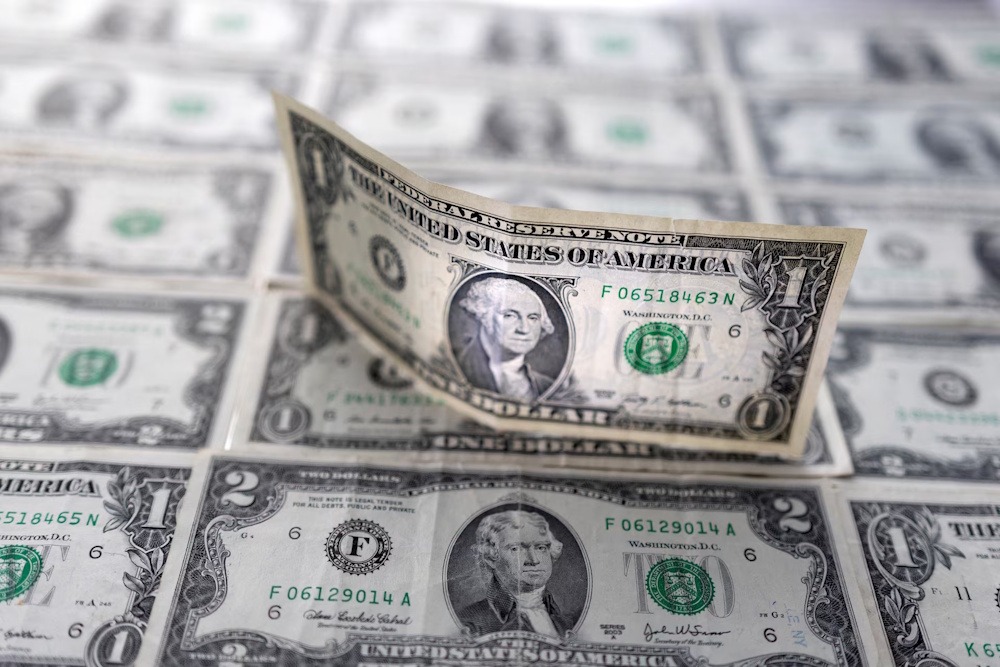
The dollar declined on Monday as investors, unsettled by U.S. President Donald Trump’s recent tariff threats against Europe regarding Greenland, sought refuge in the safe-haven yen and Swiss franc, reflecting a widespread risk-averse sentiment across markets. Over the weekend, Trump announced plans to implement an additional 10% import tariff starting February 1 on goods from Denmark, Norway, Sweden, France, Germany, the Netherlands, Finland, and Britain, contingent upon the United States being permitted to purchase Greenland. Prominent European Union nations condemned the tariff threats concerning Greenland as a form of blackmail on Sunday, with France suggesting a response that includes a variety of previously untested economic countermeasures. In the foreign exchange market, the initial response in early Asia trade was to sell the euro and sterling, resulting in a decline to a seven-week low and one-month trough of $1.1572 and $1.3321, respectively.
However, the two currencies rebounded from their lows, with the dollar facing pressure as the trading day commenced, as investors evaluated the long-term effects of Trump’s recent actions on the greenback’s position. The euro managed to reverse its losses, appreciating by 0.21% to reach $1.1623, while the British pound also saw a recovery of 0.11%, trading at $1.3390. “Typically, one might expect that threatened tariffs would result in a weaker euro. However, as observed last year during the implementation of the Liberation Day tariffs, the effect in FX markets has consistently leaned towards dollar weakness whenever there is increased policy uncertainty originating from the U.S.,” stated Khoon Goh.
In the aftermath of last April’s “Liberation Day” announcement, investors abandoned the dollar following Trump’s introduction of extensive tariffs on global trade, leading to a significant decline in confidence regarding U.S. assets.
A similar trend played out on Monday, as the greenback slid 0.36% against the safe-haven Swiss franc to 0.7993, and was down 0.24% to 157.74 yen. The dollar index has shown a minor decline, now standing at 99.18. “While you would argue that the tariffs threaten Europe, in fact, it’s actually the dollar that is bearing the brunt of it, because I think markets are pricing in increased political risk premia on the U.S. dollar,” said Goh. Cryptocurrencies, frequently regarded as indicators of risk sentiment, experienced significant sell-offs. Bitcoin experienced a decline of over 3%, settling at $92,477.54, whereas ether saw a drop of approximately 4%, now priced at $3,203.13.
On Monday, data from Asia revealed that China’s economy expanded by 4.5% in the fourth quarter compared to the previous year, slightly surpassing analysts’ expectations and aligning perfectly with the government’s annual growth target. The onshore yuan remained relatively stable at 6.9647 per dollar after the release, whereas its offshore counterpart showed slight strength at 6.9608 per dollar. The Australian dollar, frequently regarded as a liquid proxy for the yuan, also remained unchanged in response to the data. It was last down 0.09% at $0.6685, as it continued to face pressure from the overall risk-off sentiment. The New Zealand dollar experienced an increase of 0.25%, reaching a value of $0.5766.