
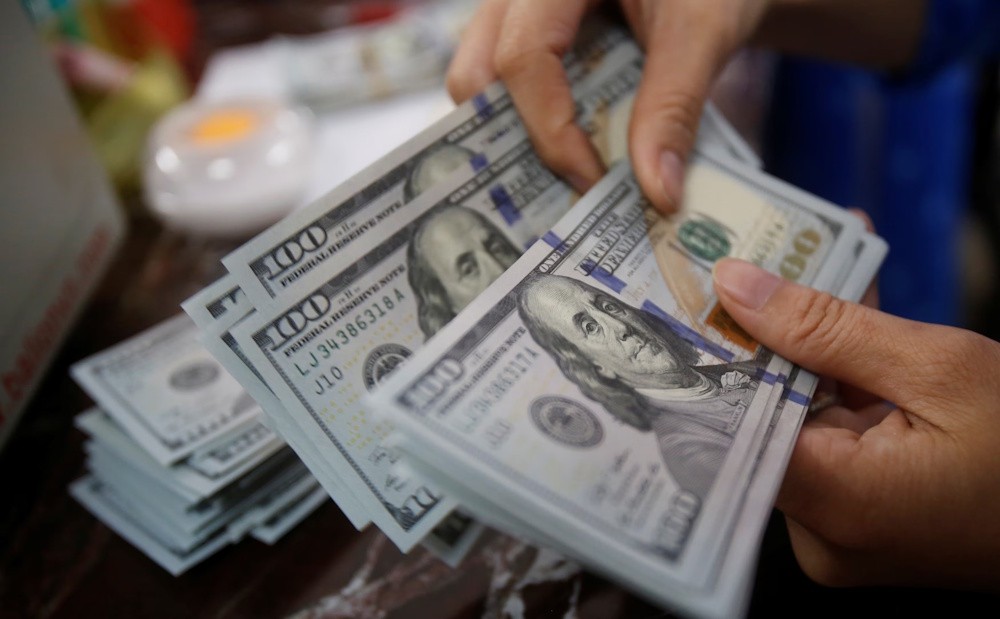
The dollar maintained its losses on Tuesday following the Trump administration’s initiation of a criminal investigation into Federal Reserve Chair Jerome Powell, a development that jeopardizes the central bank’s autonomy and confidence in U.S. assets. Investors were still attempting to understand the implications of the probe disclosed late on Sunday, a development that faced criticism from former Fed leaders and signified a significant intensification in the U.S. president’s efforts to urge the central bank to expedite rate cuts. The market response has involved a sell-off of the dollar and U.S. Treasuries, with a sense of unease driving some investors to pursue safety in gold. However, the selloff was considerably more restrained than the one that ensued after Trump’s extensive tariffs last April.
“The episode was mild, with losses in both USD and USTs fractional, as markets probably believe this is an act of threat that will blow over,” said Vishnu Varathan. The euro remained stable at $1.1663 during early trading in Asia, after an increase of 0.5% in the prior session. Meanwhile, sterling also showed minimal movement at $1.3463, maintaining Monday’s gain of 0.47%. The Swiss franc attracted more safety bids, showing slight strength at 0.7974 per dollar. Meanwhile, the dollar index stood at 98.92, having experienced its worst day in three weeks during the prior session. “The outlook for the dollar is somewhat mixed,” stated Sim Moh Siong. Regarding the actions of the Fed, it would be prudent for them to exercise caution in cutting rates, especially in light of data indicating the economy’s resilience. However, there remains uncertainty about the Fed’s eventual course of action. “If the political pressure on the Fed intensifies, the Fed may turn dovish and potentially cut rates much more than warranted by the economy.” The recent actions of the Trump administration have had minimal impact on market predictions regarding two additional Fed cuts this year. However, this situation brings to light concerns regarding the independence of the central bank, which is fundamental to U.S. economic policy and a key element of its financial system.
Fitch Ratings stated on Monday that it considers the independence of the Fed to be a crucial element supporting its AA+ U.S. sovereign rating. U.S. Treasury yields experienced a modest decline on Tuesday following the gains observed in the previous session, with the benchmark 10-year yield recorded at 4.1713%, while the two-year yield remained close to Monday’s three-week peak, currently at 3.5323%. The yen was navigating its own course against other currencies, influenced by the potential for a forthcoming snap election domestically. Japanese Prime Minister Sanae Takaichi is contemplating an early general election, as indicated by the leader of her party’s coalition partner on Sunday, following media reports suggesting a potential vote in February.
The yen has declined to a one-year low of 158.285 per dollar, while Japanese government bonds are also experiencing selling pressure. Japan’s Finance Minister Satsuki Katayama expressed that she and U.S. Treasury Secretary Scott Bessent have aligned concerns regarding what she referred to as the yen’s recent “one-sided depreciation.” Carol Kong said “Markets will probably price in a scenario where Takaichi’s coalition will gain more seats in the powerful lower house, and therefore that will enhance her ability to further loosen fiscal policy and potentially monetary policy.” The primary factor contributing to the current depreciation of the yen is the ongoing speculation surrounding it. In other markets, the Australian dollar remained steady at $0.6710, whereas the New Zealand dollar experienced a slight increase of 0.05%, reaching $0.5775. A private survey released on Tuesday indicated that consumer sentiment in Australia declined in January, as households grappled with renewed concerns over interest rates and an uncertain economic landscape. On the same day, a private think tank reported that New Zealand’s business confidence in the fourth quarter has improved, reaching its highest level since March 2014.