
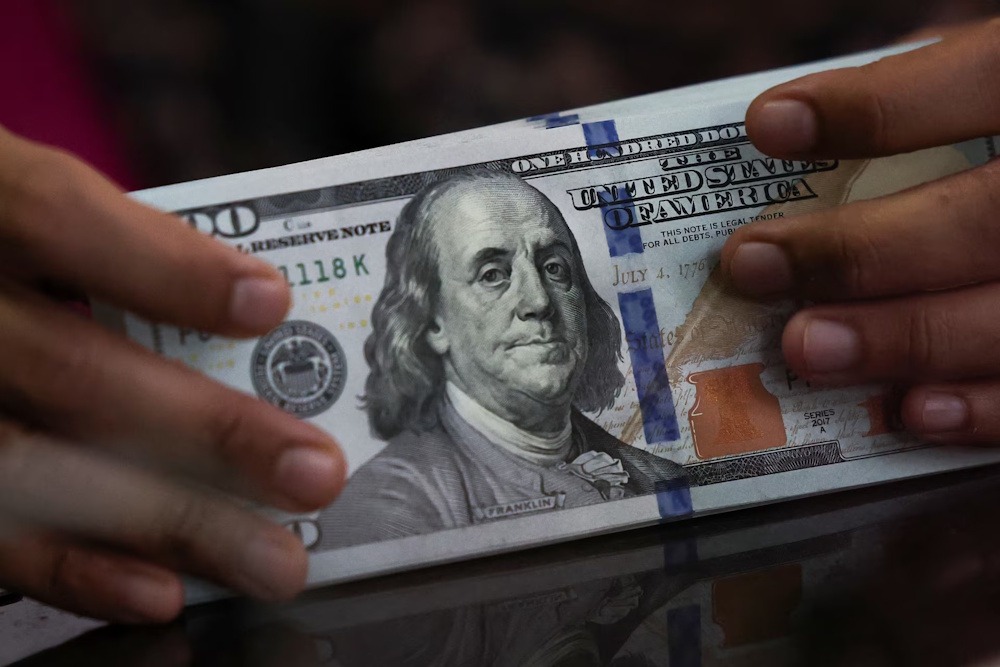
The dollar was set on Friday to conclude its most robust weekly performance since October, supported by a series of better-than-anticipated economic indicators, a more aggressive stance from the Federal Reserve, and ongoing tensions between the U.S. and Iran that kept markets unsettled. Overnight, the dollar received an additional boost as data revealed that the number of Americans submitting new applications for unemployment benefits decreased more than anticipated last week, highlighting the stability of the labor market. It maintained its gains during early Asia trade on Friday, leaving sterling hovering close to a one-month low at $1.3457. The outlook indicated a potential weekly decline of approximately 1.5%. The euro experienced a slight decline of 0.02%, trading at $1.1768, and is poised to finish the week down 0.8%. This common currency faces pressure due to uncertainty surrounding the tenure of European Central Bank President Christine Lagarde.
The dollar remained steady against a range of currencies, positioned close to Thursday’s one-month high, last recorded at 97.89. It was poised for a weekly gain exceeding 1%, indicating its most robust performance in over four months. “It wouldn’t surprise me if the U.S. dollar keeps lifting for a while longer,” said Joseph Capurso citing hawkishness from this week’s Fed minutes which showed several policymakers were open to rate hikes if inflation proved sticky. This week, the dollar has received some safe-haven support due to concerns surrounding a potential conflict between the U.S. and Iran. U.S. President Donald Trump issued a stern warning to Iran on Thursday, stating that the country must reach an agreement regarding its nuclear program or face “really bad things.” He established a timeframe of 10 to 15 days for this deal, prompting a response from Tehran, which threatened to retaliate against U.S. bases in the region if provoked. The potential for adverse developments in that region could significantly impact both oil and currency markets. “It will serve as an evaluation of the U.S. dollar’s status as a safe haven,” stated Capurso. A significant assault would raise doubts about that.” The attention of the markets is now directed towards the upcoming release of the U.S. core PCE price index and the advance fourth quarter GDP figures later today, which may influence the next movement in currencies. Market participants are factoring in approximately two Federal Reserve rate reductions this year.
However, the likelihood of a cut in June has decreased to about 58%, down from 62% the previous week, as indicated by the CME FedWatch tool. The central debate among Fed officials revolves around the decision to either lower rates proactively to bolster the job market or maintain elevated rates for an extended period to combat inflation,” stated Chris Zaccarelli, noting that Friday’s PCE report will “contribute to the discussion”. In other markets, the Australian dollar experienced a decline of 0.08%, trading at $0.7055. However, it is poised to end the week with a modest loss of only 0.2%, supported by strong rate expectations domestically. The New Zealand dollar faced some challenges, on track for a 1.2% weekly decline, influenced by a dovish perspective on interest rates from the Reserve Bank of New Zealand. Investors anticipating stricter policy found themselves significantly misaligned, as a flurry of reductions unfolded over the past year or so. The kiwi concluded its trading session at $0.5967, reflecting a decline of 0.12%.
In Japan, the yen declined by 0.05% to 155.08 per dollar, reversing minor gains from earlier in the session following data released on Friday, which indicated that the country’s annual core consumer inflation reached 2.0% in January, representing the slowest rate in two years. “Today’s data won’t exactly instil a sense of urgency in the (Bank of Japan) to resume its tightening cycle, especially given the lacklustre rebound in activity last quarter,” said Abhijit Surya. Nonetheless, if our analysis holds that the recent downturn will not be long-lasting, coupled with an increase in wage growth and persistent underlying price pressures, there remains a compelling argument for the bank to consider raising rates once more in June.